Most of us grew up believing that “math begins with counting.”
One-two-three-four, beads on a string, fingers in the air — the familiar rituals. Counting certainly matters, but it’s only one instrument in a much larger orchestra. Children use several different kinds of number sense long before they can write numerals, and the strength of these early foundations shapes everything that follows.
Understanding these layers helps us design better learning tools and, more importantly, helps children develop a relationship with math that feels natural instead of forced.
1. Counting Sense: The First Ladder
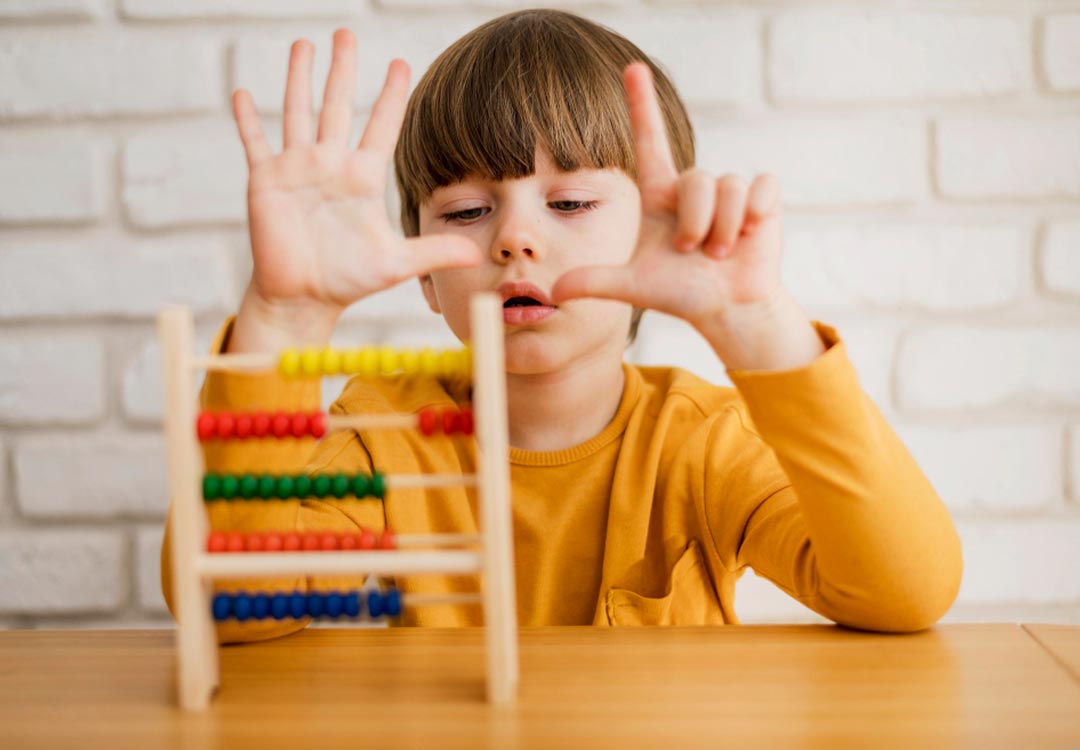
Counting is the simplest and most visible form of number sense. Children move step by step, adding one each time — one, then another, then another. Beads, abacuses, and tally marks all work beautifully here.
Counting helps children arrive at a number, but it doesn’t help them understand what the number means. It is slow & linear. Many children continue to rely on counting even in higher grades simply because no one introduced them to the deeper layers of number sense.
2. Quantity Sense: The Feel of “How Much”
Quantity sense is the quiet powerhouse behind intuitive math.
It’s the ability to instantly feel that 5 is bigger than 3 — without counting.
Infants have this ability. Long before they learn to speak, they know the difference between “a little” and “a lot.” This innate sense is rooted in perception: our brains understand differences in size, length, height, and mass effortlessly.
Tools that use proportional size, such as length-based number blocks, plug directly into this system. When a “3 block” is physically longer than a “2 block,” children experience magnitude with their senses. Quantity becomes something they can see and touch, not just recite.
3. Part–Whole Sense: The Secret Engine of Arithmetic
Part–whole thinking is the understanding that numbers can be broken apart and put back together.
5 is 2+3.
5 is also 4+1.
10 is 6+4.
And many more.
This flexible understanding is the foundation of addition, subtraction, fractions, and eventually algebra.
Counting tools rarely support this insight because every bead looks the same. In contrast, proportional blocks naturally reveal these relationships. When children line up a 2 block and a 3 block next to a 5 block and they match perfectly, the equation becomes self-evident.
Math turns from “remembering steps” into “recognising patterns.”
4. Spatial–Relational Sense: Seeing Patterns in Numbers
Humans are built for pattern recognition.
When children arrange objects, align blocks, or compare lengths, they’re exercising spatial–relational thinking.
This form of number sense is what makes measurement, geometry, music rhythms, and even logical reasoning easier later on. It helps children make sense of how numbers relate in space — larger, smaller, equal, double, half.
Proportional manipulatives tap this beautifully because they behave like the real world: longer means more, shorter means less.
5. Symbol Sense: Bridging Objects and Abstraction
Symbols come surprisingly late in a child’s development.
The written “5” is just a squiggle until it’s linked to an idea the child already understands.
When children have strong quantity and part–whole sense, numerals stop being arbitrary marks. “5” becomes a label for a magnitude they can already feel. This makes arithmetic not just easier — it makes it meaningful.
Why This Matters
When children rely only on counting, they stay in a narrow corridor of math.
When they develop all these forms of number sense together, math opens up into a landscape.
They stop asking “What comes after 7?” and start noticing “This is longer than that,” “These two fit together,” or “This feels like double.”
They shift from doing math to understanding math.
That’s the real goal — not faster counting, but deeper comprehension.